Serbs, as an ethnic and religious community, have lived on the territory of present-day Hungary (or the former Hungary) since the beginning of the 15th century, for at least six centuries. However, the roots of the Serbian presence in this country reach back to the time of the Hungarians' settlement in the Pannonian regions, at the end of the 9th century. The center of the mission of Cyril and Methodius in the 9th century in Pannonia was in Koceljevo and Pribinin Blatograd in the vicinity of present-day Zalavar in Hungary, where the oldest Glagolitic fragments were found on ceramics. On the southern edge of early Hungary, the Slavic ancestors of the Serbs of the "Greek rite" are present. During the rule of the Arpadovićs, Serbian-Hungarian dynastic ties were established: in the 12th century, the daughter of the Grand Count Uroš I, Jelena, married the Hungarian King Bela II the Blind and, together with her brother Beloš, the Palatine of Hungary, ruled the country. In the 13th century, the Serbian King Dragutin, married to the Hungarian Princess Katalina, after abdicating from the Serbian throne, ruled Mačva and the neighboring regions, which were then border areas under the rule of Hungary.
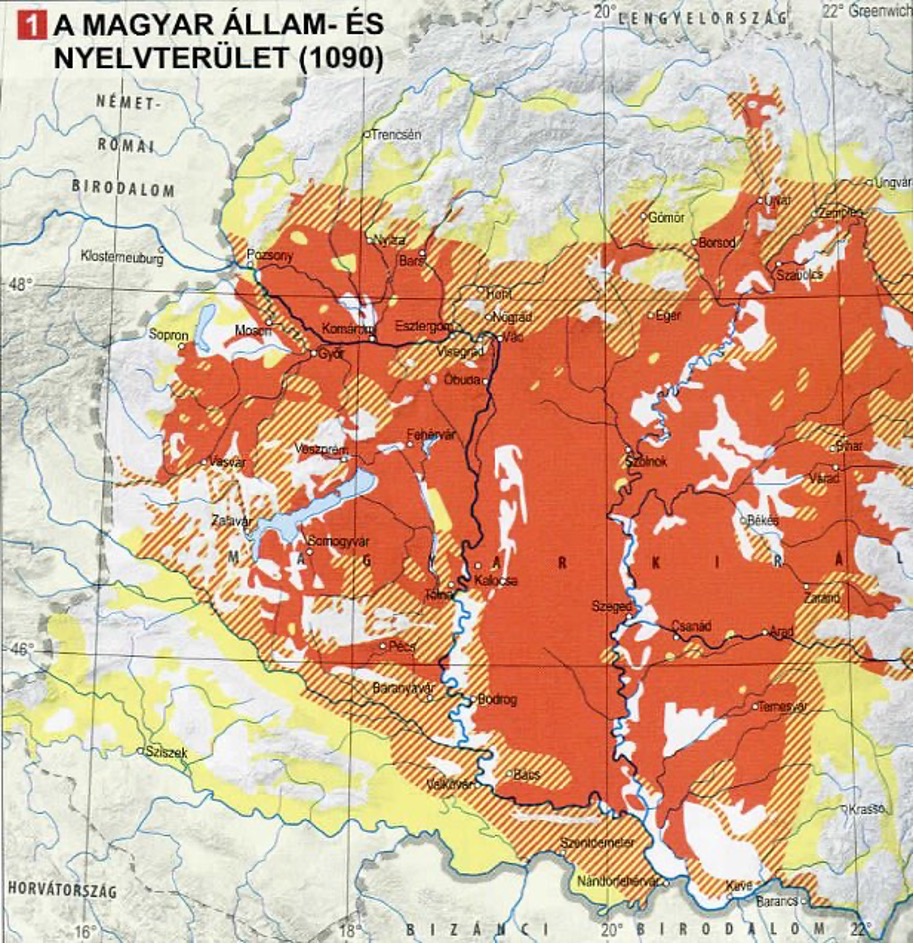
Map No. 1. Slavic-speaking area in western and central Hungary at the end of the 11th century (map detail). The Slavic-speaking area is marked in yellow, and the mixed Slavic-Hungarian area is shaded. (Kocsis Károly et al: Magyarország nemzeti atlasza : Állam és nemzet, HUN-REN Magyar Kutatási Hálózat, Budapest, 86.r)
During Saint Sava's diplomatic mission around 1220 to the Hungarian King Andrew II, it is assumed that an agreement was reached for the Serbian Orthodox Church to take care of the Orthodox in Hungary, who until the fall of Byzantium in 1204 were under the patronage of Constantinople.
Due to the Turkish invasion of the Balkans, from the end of the 14th century, a strong migration of Serbs began to the north and west – and thus to Hungary – which lasted until the beginning of the 19th century. In the first half of the 1400s, the Serbian Despotate came into dual dependence on the Ottomans and Hungary, however, the Serbian Despots Stefan Lazarević and Đurađ Branković acquired huge estates in the south and interior of Hungary and became one of the main magnates in the state. In Buda, the capital of Hungary, the Despots had a palace, and in the company of Despot Stefan in the city, the great dignitary of the Serbian Orthodox Church, Sava, is also mentioned. After the first fall of Smederevo in 1439, Serbian merchants and craftsmen from Kovin on the lower Danube fled from the Turks and in 1440 founded Serbian Kovin, with city privileges on Čepeljsko Ostrvo (later called "Kovinska Ada"), less than 50 km south of Buda. During the battles against the Turks and the century-and-a-half-long occupation of central Hungary by the Ottomans, the Serbs in Hungary, called Racima in Hungarian at that time (after Raška and Ras), became a significant demographic, economic and military factor. After the fall of the Despotate, part of the Serbian nobility entered Hungarian service and continued the fight against the Turks from its southern regions. The Jakšić brothers were given the administration of Nađlak and its surroundings, near Batanja, Pavle Bakić participated in the Battle of Mohács in 1526 and was the last Serbian (titular) despot, who died in the Battle of Gorjan in 1537, and Stefan Štiljanović from Paštrović performed military duties in Slavonia and Srem, and around 1543 he died and was buried near Šikloš, in the territory of present-day Hungary. Serbs mostly became commanders and provided a large part of the crew of the Hungarian river flotilla on the Danube (nasadisti, šajkaši). In the 15th century, Hungarian kings granted various local and wider, temporary and permanent privileges to newly settled Orthodox Serbs.
With the settlement of Serb farmers and herders, especially in the first half of the 17th century, entire smaller areas called "Racšag", "Racorsag" (= Serbian land) emerged in the interior of Hungary. In the cities we find Serbian Orthodox merchants and craftsmen with their own local personal self-government (princes), and after 1557 the restored Patriarchate of Pec expanded its jurisdiction to areas under Turkish rule on Hungarian soil. In addition to Timisoara and Szeged, a Serbian Orthodox religious center was established in Buda, and the names of the Buda bishops have been preserved since the first half of the 17th century. In 1585, monks from the Dragović Monastery in Dalmatia arrived in northern Baranja (south of Tolna County) and founded the Serbian Orthodox Monastery of Grabovac. Serbian church buildings from the pre-Turkish and Turkish periods in the interior of Hungary have not been preserved, except for the church in Srpski Kovin, built in 1487. The Serbian monasteries in Fruška Gora, in the south of what was then Hungary, founded mostly during the 16th century, and whose construction was still being begun by the descendants of Despot Đurđe Branković, have been preserved for the most part in their restored, Baroque form.
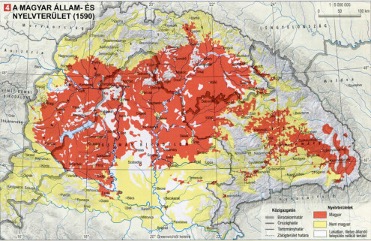
Map No. 2. Ethnic areas in Hungary in 1590, according to research by Hungarian historians. Red indicates areas where the majority of the population is Hungarian, and yellow indicates areas where the majority of the population is non-Hungarian. White and gray indicate uninhabited, deserted areas. Banat, Bačka and Syrmia are dominated by Serbian population. (Kocsis Károly et al: Magyarország nemzeti atlasza : Állam és nemzet , HUN-REN Magyar Kutatási Hálózat, Budapest, 87.r)
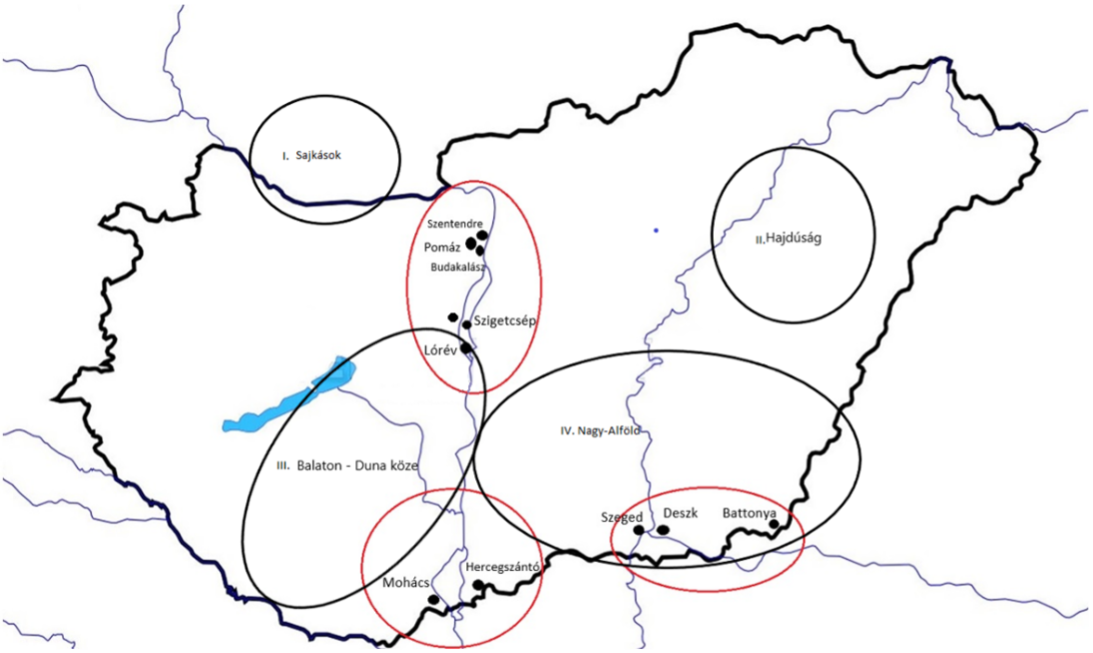
Map No. 3. Areas inhabited by Serbs. Historical and present-day areas in the territory of modern Hungary in which there are settlements in which Serbs lived/are living. Areas in black are circled where there was a significant Serbian presence throughout history, but there are no longer any traditional Serbian communities in them today. I: Parts of settlements in which Serbian sajkas and merchants lived between the 16th and early 18th centuries along the Danube and the Vah River (Hungarian: Vág), e.g. Đur, Komorán. II: In the area around Debrecen called Hajdusag (after the so-called "hajdus" - policemen), Serbs lived mainly in the 15th - 17th centuries, before they assimilated. III: In Transdanubia, in the area bounded by the lines of the Danube and Balaton, during Ottoman rule, Serbs lived compactly from the second half of the 16th century until the Rákóczi Rebellion (1703–1711). IV: In the region of the Great Plain, even in its central part, from the first half of the 17th century to the first half of the 18th century, we find scattered settlements in which Serbs also live.
We have circled in red the areas where we find settlements where Serbs traditionally live today: the Budapest area in the Danube region, the Bačka-Baranja region, and Pomorie (the northern edge of Banat).
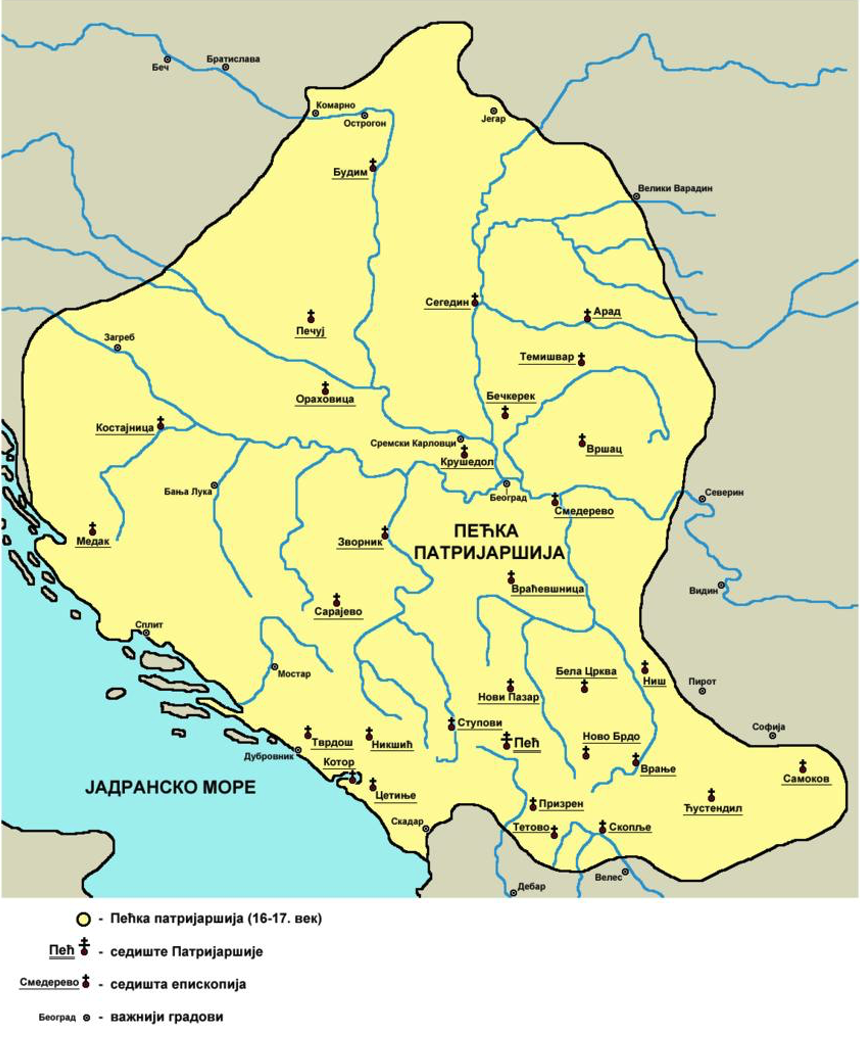
Map No. 4. The restored Patriarchate of Peć (Free-Images.com)
The Turkish period in Hungary was also the period when Serbs first emerged as an independent factor in these areas. In the turmoil and collapse of state power in southern Hungary after the Battle of Mohács in 1527, for a short time, in the fight against the Hungarian nobility and on the side of the Habsburg ruler Ferdinand, the outlines of a region under the rule of "Emperor" Jovan Nenad, known as "The Black Man", who relied primarily on armed, combat-ready Serbs in southern Hungary, were formed. However, his movement was short-lived. The Serbs raised an uprising against the Turks in Banat in 1594, expecting help from the Prince of Transylvania. The uprising was bloodily suppressed, the Bishop of Vrsac Nestor was cruelly tortured and killed, and the relics of Saint Sava were brought from the Mileševa Monastery and burned at Vračar near Belgrade.
Pera Lastić